
Keir needs Cojones
A Spanish lesson for our embattled Prime Minister

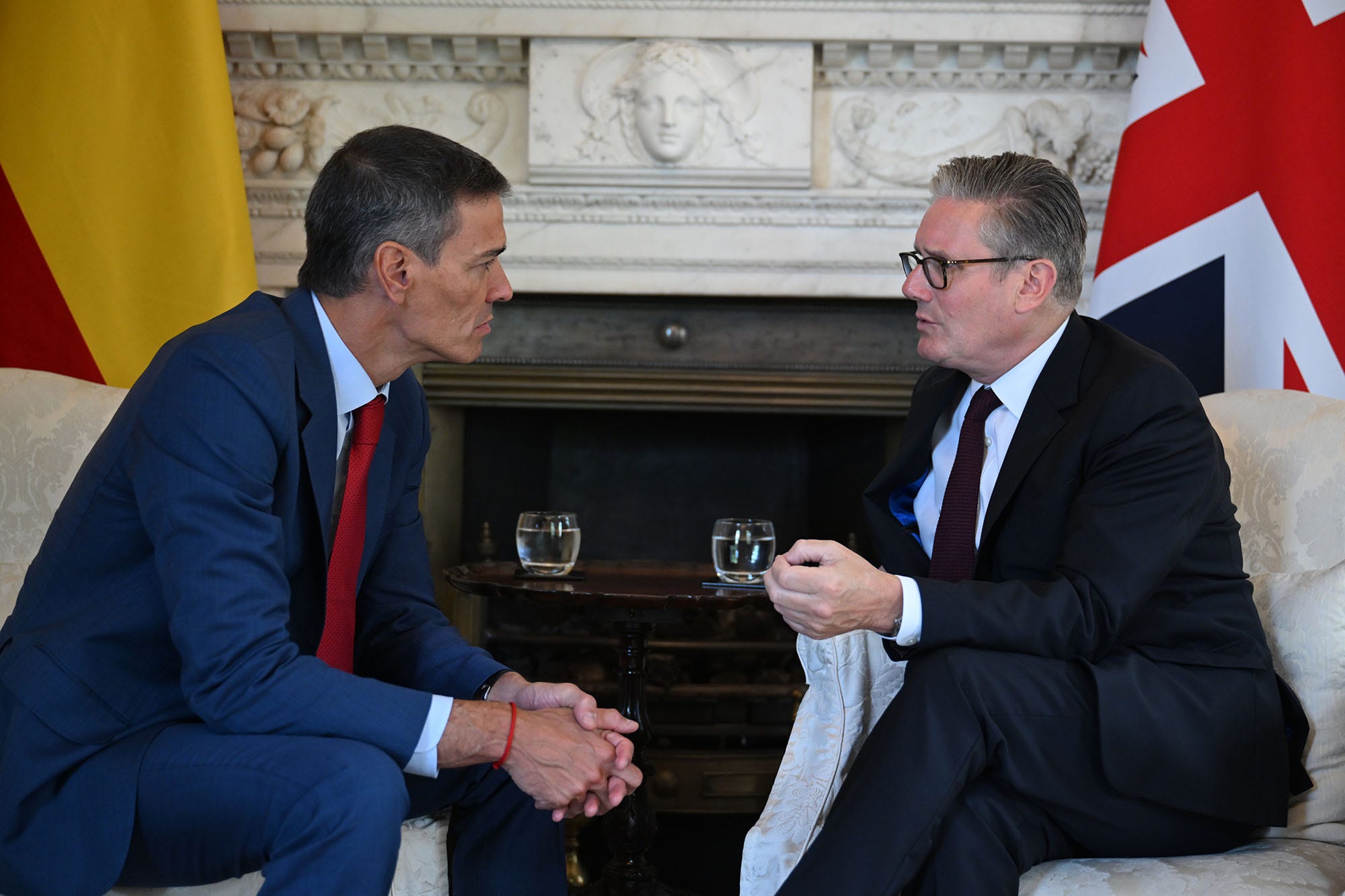
A centre-left Prime Minister faced with constant scandal, an ascendant far right, and without a governing agenda. To British ears this will all sound very familiar, but this isn't Keir Starmer, it’s Spain’s Pedro Sánchez. The two Prime Ministers met last week and both returned to immediate political trouble at home. In London, the Angela Rayner scandal reached its conclusion, and in Madrid another charge was levied at Sánchez’s wife. However, sipping his caña, Sánchez remains indomitable in a way that weary Keir could never be as he nervously reaches for a Camden Hells while watching The One Show.
Pedro Sánchez should be finished. In the last few months he has seen his Attorney General charged with sharing confidential documents, his wife investigated for corruption, and a huge corruption scandal involving his closest political allies. He is not even able to pass key legislation which would have lowered the maximum number of hours that could be worked due to the opposition of the Catalan Conservatives, Junts. Despite this he is on the offensive and buoyant in the polls with one giving him a new lead over the centre-right Partido Popular (PP). Sánchez is a fighter who delights in the game of politics and the struggles of personalities. He has a thirst for power and, in the words of novelist Arturo Pérez-Reverte, would “sell his mother and then hand over yours instead.” He is a pistolero — a gunman with his sights set solely on how to maintain own position.
While Keir Starmer may share the scandals and inability to pass legislation, he seems to completely lack Sánchez’s matador-like composure. While the reshuffle may have taken the headlines away from Reform’s conference and Angela Rayner’s fall, his launch of Phase 2 has been completely overshadowed by it and the Mandelson affair. One is constantly looking for a target while the other is always one himself.
When in 2023 Sánchez lost heavily in the local elections, he called a snap election despite being heavily behind in the polls. He did so on a platform of opposing the far-right Vox and, despite the resurgence of the PP, he held on to enough votes to maintain power by a single seat. The notion of risking it all rather than succumbing to a slow death is the polar opposite of Starmer, whose glacial approach seems only to result in a melting political authority.
At this moment in time, with Sánchez in trouble again because of his wife’s alleged corruption, he has found a new target. A focus on the “genocide in Gaza” has led to a spat with Israel’s government and forced the issue onto Spain’s front pages. This has even extended to the government spokesperson saying Israel, like Russia, should be removed from international sporting events. Israel’s war is decidedly unpopular in Spain, and so forcing the right — who have the standard Western conservative Zionist leanings — to argue on this terrain has alleviated some of the pressure. Like in Britain, the conflict in Gaza has provided a rally-around-the-flag moment for the left, but here this is directed against Starmer.
Of course, the Spanish PM has some things going for him: a left which is broken in two because of breathtaking factional infighting, and an array of separatist parties who are all unable to remove him for fear of bringing about a conservative government. The migration issue is, like in Britain, an important one, but it hasn’t turbocharged debate in the same manner the use of asylum-seeker hotels has here. That said, it cannot be forgotten that Starmer, however bedraggled he may be, has years of government ahead of him and a majority orders of magnitude larger than his Spanish counterpart.
So how can Starmer learn from Sánchez? Some things like grinta — from the wonderful vocabulary of Italian cycling — cannot be learned, but others can. Sánchez is adept at choosing his enemy and attacking it. From Vox and Netanyahu to the aged, corrupt ranks of the PP, he is skilled at setting the agenda and forcing the Spanish public to pick sides on an issue which runs in his favour. Spain is a conservative country, but with the help of separatists he can remain in power despite coming second in 2023’s general election. Now things may seem dire for Labour, but a similar scenario could well happen in Britain if it scraped its way to the high twenties.
Much has been said of the Labour Prime Minister’s lack of political definition. The lesson from Sánchez is not that Starmer has to have any scruples, never mind principles to guide him, but that he needs an enemy. At every turn the PM seeks to mollify a segment of public opinion but, in doing so, he is incapable of being friends with anyone and instead becomes a universal enemy. It’s thus not surprising that his only success has been found when his only focus was the final destruction of the Conservative government’s charred corpse. He has tried to imitate this anything-but-forensic strategy against Nigel Farage but, in the same instance, echoes the anti-immigration message of the Reform UK leader despite not having the wherewithal to quell it. Even if such a unifying enemy may not exist he should at least try and invent a convincing one.
Clearly there are constraints: his own MPs, the loss of the left due to his early position on Gaza, and the bond market. The above do not damn the PM, but the inability to use the power he possesses does. To use a phrase Pedro Sánchez would be familiar with: mucho arroz para tan poco pollo.